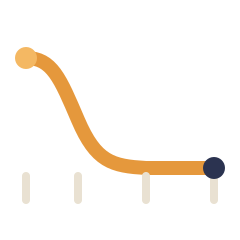
What does the weight loss timeline look like on a GLP-1?
In the semaglutide obesity trial, mean weight loss reached 17.3 percent over 68 weeks, with the steepest period in the middle and a flattening toward the end. Doses are increased gradually at the start, and appetite typically drops with each step. Protein becomes harder to reach exactly as it starts to matter more.
Key takeaways
- In the semaglutide obesity trial, mean loss reached 17.3 percent of body weight over 68 weeks.
- The curve is steepest in the middle and flattens toward the end. A slowing rate is expected rather than a failure.
- Each dose increase typically brings a dip in appetite and intake, then a recovery. That is a pattern worth planning around.
- Your protein target is per kilogram, so it falls as you do. Recalculate every couple of months.
- The phase after stopping is the one with the least data, and it is where regain happens.
The eating problem is different in each phase, and knowing which phase you are in makes the advice easier to apply. The numbers below are trial means, and individual results vary widely around them.
- Titration, the first weeksDoses start low and step up. Weight loss is modest and appetite is already changing. This is the cheapest time to build the habits, because you can still eat normally.
- The steep middleThe fastest loss, and the point at which composition matters most. Protein and resistance training are doing their work here or they are not.
- The flatteningThe rate slows as the body gets smaller and the dose stops rising. Your protein target falls with your weight, so it is worth recalculating.
- After, whenever that comesThe phase with the least data and the most at stake. Appetite returns, and the habits either exist or they do not.
The shape of the curve
In the semaglutide obesity trial, mean weight loss reached 17.3 percent of body weight over 68 weeks.1
That average conceals the shape. The early weeks are titration and produce relatively little. The middle stretch is the steepest. The last months flatten out, for two reasons that both make sense: a smaller body needs less energy, so an unchanged intake is a smaller deficit than it was, and the dose has stopped rising.
The practical consequence is that a slowing rate is the expected shape, not evidence that something has stopped working. People who read the flattening as failure often respond by eating less again, which is the point at which lean mass is most at risk.
Why the dose steps matter for eating
Doses are increased gradually. What people report, consistently, is a dip in appetite and intake in the days following each increase, then a partial recovery.
That is a pattern rather than a surprise, and it can be planned for:
- Keep something easy and protein-dense in the fridge before the increase, not during.
- Expect the training week after an increase to be lighter, and shrink the sessions rather than skipping them.
- Do not read a low week as a new baseline. It usually is not.
What to eat when nothing appeals covers the food side of those weeks.
Your target moves as you do
Protein recommendations are per kilogram of body weight, which means the grams change through the timeline.
| Weight | At 1.4 g/kg |
|---|---|
| 115 kg at the start | 161 g |
| 100 kg | 140 g |
| 90 kg | 126 g |
| 82 kg after 17 percent | 115 g |
Recalculating every couple of months is enough. Carrying the starting figure forward is not harmful, and it stops matching the recommendation fairly quickly. How the target is derived, and why it is borrowed has the caveats.
The phase nobody plans for
The trial extension followed a subset of participants for a further year after stopping, with no drug and no lifestyle programme. They regained 11.6 of the 17.3 percentage points, finishing around 5.6 percent below where they started.2
Two honest readings sit in that sentence at once: most of the loss came back, and some of it did not.
The extension reported weight, blood pressure, HbA1c and lipids. It did not report lean or fat mass, so the composition of the regain is not something anybody can tell you.2 Given that roughly a quarter of the loss on these medications is lean tissue, that is a substantial gap in what is known.3
What to keep doing after the last dose is the page for that phase.
The line
These are prescription medications and this page is general reference material about protein, not medical advice. Dose schedules, how long to stay on treatment, and how or whether to stop are decisions for the clinician who prescribed yours. If your weight is falling faster than expected, or you are noticing weakness, that is a conversation with them rather than an adjustment to a target.
More questions about GLP-1
How fast does weight come off on a GLP-1?
In the semaglutide obesity trial the mean was 17.3 percent of body weight over 68 weeks, which is a little under a percent a week on average and not evenly spread. The early weeks are titration and produce less; the middle is steepest; the last months flatten. Individual results vary widely around that mean.
Why does weight loss slow down after several months?
Partly because a smaller body needs less energy, so the same intake is a smaller deficit than it was, and partly because the dose stops rising. A flattening curve is what the trial data shows too, so it is the expected shape rather than a sign something has stopped working.
What happens when I stop?
The trial extension followed people for a year after stopping, with no drug and no lifestyle programme, and they regained 11.6 of the 17.3 percentage points. Body composition was not reported, so what the regained weight was made of is genuinely unknown. Stopping is a decision for your prescriber, including the question of how.