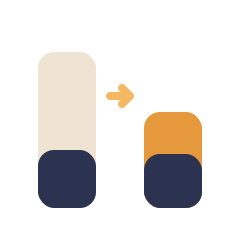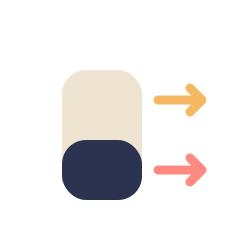
How do I know if I am losing muscle instead of fat?
The scale cannot tell you, because it reports both as one number. The accessible signals are strength, which should hold or improve during a sensible deficit, and a tape measure, which responds to fat distribution. Falling strength alongside falling weight is the clearest sign the composition is going the wrong way.
Key takeaways
- The scale reports fat and muscle as one number, so it cannot answer this question at all.
- Strength is the most accessible signal. It should hold, or improve, through a sensible deficit.
- A tape measure responds to fat and is free. Take it monthly at the same point.
- Three things drive the wrong outcome: too large a deficit, too little protein, and no resistance training.
- Losing weight quickly with no training and low protein is the pattern that costs the most muscle.
Weight going down is not automatically good news, and the instrument almost everyone uses cannot tell the difference. Here is how to find out without buying anything.
Why the scale cannot answer this
It measures one number for two tissues moving independently. Lose 2 kg of fat and gain 0.5 kg of muscle and it reports 1.5 kg. Lose 1 kg of fat and 0.5 kg of muscle and it reports 1.5 kg. Same reading, very different outcomes.
This is the same measurement problem that makes the menopause transition so confusing to track, where fat rises and lean mass falls and the scale reports nothing at all.
The signals that do work
| What it tells you | Cost | |
|---|---|---|
| Strength over weeks | The most sensitive available signal. Holding or rising is good news | Free, needs a record |
| Tape measure at the waist | Responds to fat, monthly, at the same point | Free |
| How clothes fit at the same weight | Crude composition read, and better than the scale | Free |
| DXA scan | Measures it properly. Useful twice, months apart | Paid, and worth it if the answer matters |
| Bioimpedance scale | Unreliable per reading, hydration moves it. A trend at best | Cheap, and easy to over-trust |
Strength is the one to lead with, and there is a reason beyond convenience. The revised European consensus on sarcopenia puts low muscle strength first as the diagnostic parameter, with muscle quantity moved to a confirming role, because strength predicts outcomes better than mass does.2
You do not need a gym to record it. Five chair rises timed, how many press-ups you can do, how heavy a bag you can carry up the stairs without stopping: any of those, written down with a date, is a measurement.
What drives the wrong outcome
Three things, and they usually arrive together.
A deficit that is too aggressive. The larger the daily shortfall, the more of the loss comes out of lean tissue. Fast is not free.
Protein below the range. Across 24 trials, higher protein groups kept about 0.43 kg more fat-free mass and lost about 0.87 kg more fat than standard protein groups, at similar total weight lost.1
No resistance training. Loading is the signal that a muscle is worth keeping. Without it, muscle is expensive tissue with no current use, and the body treats it accordingly.
Somebody losing weight quickly, eating around the RDA, and doing only cardio is running all three at once. That is the pattern that produces the outcome this page is about, and it is extremely common.
What to change
The same three levers, and the full version is on the weight-loss side.
- Slow the deficit to something you could hold for months.
- Raise protein toward 1.2 to 1.6 g per kilogram of body weight. The arithmetic by weight is here for anyone over 50, and for women in their 40s who lift.
- Load the muscles two or three times a week. Starting after 40 works.
Fixing all three is usually easier than working out which one is responsible, and none of them requires knowing the answer first.
Where this stops being a self-assessment
Unintended weight loss, weakness that came on quickly, or strength falling despite eating and training well are worth taking to a doctor rather than treating as a diet variable. Muscle loss has causes other than dieting, and a nutrition page cannot distinguish between them. The signals above are for judging whether a deliberate diet is going well, not for diagnosing anything.
More questions about Women over 40
Can you feel muscle loss?
Not reliably, and not early. It shows up first as things being slightly harder: stairs, carrying shopping, getting off the floor. By the time it is obvious it has been happening for a while, which is why a recorded measure beats a sensation.
What if my strength is dropping in a deficit?
That is the signal worth acting on. The usual causes are a deficit that is too aggressive, protein below about 1.2 g per kilogram, or no resistance training at all. Fixing all three at once is usually easier than diagnosing which one is responsible.
Is a body composition scale accurate?
Consumer bioimpedance scales are unreliable for a single reading, because hydration alone moves the result substantially. They are somewhat more useful as a trend if you weigh under identical conditions every time. A DXA scan measures it properly, and twice months apart is the only useful way to use one.