Does eating more protein help your hair and nails?
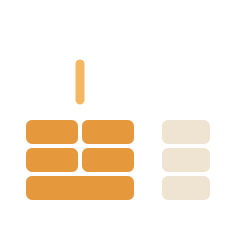
Only if you were short. Hair and nails are made of keratin, a protein, so a genuine shortfall shows up in them. Above the point where supply is adequate, more protein does not build better hair, in the way that more bricks do not improve a finished wall.
Key takeaways
- Hair and nails are keratin, which is a protein, so the mechanism is real.
- It only operates as a deficiency effect. Adequate intake plus more is not better than adequate intake.
- Hair shedding has a long list of possible causes and protein is one uncommon entry on it.
- Collagen supplements do not count toward a protein target: collagen has no tryptophan at all.
- Anything sudden or persistent about hair or nails is a question for a doctor, not for a macro adjustment.
The mechanism here is real, which is what makes the claim so durable. It is also a deficiency mechanism, and treating a deficiency mechanism as an enhancement is the mistake.
The true part
Hair and nails are made of keratin, which is a protein. So is the collagen in skin. Your body builds them out of amino acids from food, and if the supply is genuinely inadequate the building is constrained.
That is why severe protein restriction affects hair. It is a real clinical observation.
Why it does not extend upward
Being short of something and then not being short of it produces a change. Not being short of it and then having more does not.
| What happens to hair and nails | |
|---|---|
| From severely inadequate to adequate | Real improvement, because a constraint was removed |
| From adequate to more than adequate | No further effect. The constraint is elsewhere |
| From more than adequate to a great deal | Still nothing. Surplus amino acids are used for energy |
Once supply is not the limiting factor, the things setting hair growth and nail strength are genetics, age, hormones and health, and none of them respond to a bigger breakfast. More bricks do not improve a finished wall.
What actually causes hair shedding
Worth listing, because the protein explanation is usually the least likely one on it:
- Thyroid function
- Iron status
- Rapid weight loss of any cause
- Illness or a stressful period, some months earlier
- Hormonal change, including through the menopause transition
- Some medications
- Genetics and age
That is a list for a doctor to work through, and every entry on it is more common than a protein shortfall in someone eating an ordinary amount of food. Using an article to pick from it is exactly the failure mode the page on low protein intake is about: a sign that appears in twenty conditions cannot tell you which one you have.
Collagen, and a genuine trap
Collagen supplements are marketed hard for hair, skin and nails, and the evidence for the marketing is thin.
Separately from whether they work, there is a nutritional point worth knowing. Collagen contains no tryptophan at all and is low in several other essential amino acids, so it cannot be used to build body protein the way whey, eggs or soy can.2
The practical consequence is that a 10 g scoop of collagen should not be counted as 10 g toward your protein target. Plenty of people are counting it, and quietly running 20 g short every day as a result. How protein quality is scored explains why an incomplete source cannot substitute.
What to do
If you eat an ordinary amount of food, this is not your lever, and there is nothing to buy.
If you suspect your intake is genuinely low, the way to find out is arithmetic rather than symptoms: work out a target from your body weight and log an ordinary week against it. Most people who do this find they were closer to the floor than they thought, and the gap is at breakfast. How the daily number is derived has the rates.
When it is not a diet question
Hair loss that came on suddenly, is patchy, or is accompanied by anything else is a reason to see a doctor. So are nail changes in shape, colour or texture, which occasionally reflect something worth investigating. Neither belongs with a nutrition page, and both have causes that a protein target cannot address.
More questions about Women over 40
Will more protein make my hair grow faster?
Not if you were already eating enough. The relationship is a deficiency one: too little protein constrains what the body can build, and above that point the constraint is somewhere else. Rate of hair growth is set mostly by genetics, age and hormones, none of which respond to a higher intake.
Is collagen good for hair and nails?
It is heavily marketed for it and the evidence is thin. Separately from whether it works, collagen should not be counted toward a protein target: it contains no tryptophan and is low in several other essential amino acids, so it cannot be used to build body protein the way whey or eggs can.
Can low protein cause hair loss?
Severe protein restriction can affect hair, which is a clinical situation rather than an ordinary diet. Hair shedding in practice has many more likely causes, including thyroid function, iron, rapid weight loss, illness, medication and hormonal change. That is a list for a doctor to work through, not a reason to add a shake.
References
- Dietary Reference Intakes for Energy, Carbohydrate, Fiber, Fat, Fatty Acids, Cholesterol, Protein, and Amino Acids
- Values for digestible indispensable amino acid scores (DIAAS) for some dairy and plant proteins may better describe protein quality than values calculated using the concept for protein digestibility-corrected amino acid scores (PDCAAS)