Can you build muscle while losing fat?
Some people can: beginners, people returning after a break, and people carrying a lot of fat to start with. For a trained person in a meaningful deficit, keeping what you have is the realistic aim, and the evidence for doing that is strong: higher protein groups in trials kept about 0.43 kg more fat-free mass.
Key takeaways
- Building muscle and losing fat at once is possible for a specific group, not for everyone.
- Beginners, returners after a break, and people with a lot of fat to lose are the three cases where it reliably happens.
- For a trained person in a real deficit, holding what you have is the sensible target.
- The levers are the same either way: enough protein, resistance training, and a deficit that is not extreme.
- The scale cannot judge this. Strength and measurements can.
The honest answer starts with who is asking, because this is one of the rare questions where the answer genuinely differs by person.
Who can
| How likely | Why | |
|---|---|---|
| New to resistance training | Very | Early adaptations are large and come cheaply, in a deficit or out of one |
| Returning after months off | Very | Regaining previously held muscle is faster than building it the first time |
| Carrying substantial fat | Likely | A large internal energy supply to draw on, so the deficit is less of a constraint |
| Trained, lean, real deficit | Unlikely | Building tissue costs energy that is deliberately not available |
| Trained, lean, very large deficit | No | The realistic aim here is limiting the loss |
Nothing in that table is a matter of effort. It is a matter of how much room there is between where you are and what your training can produce.
The goal for everybody else
Keeping what you have. And that is worth doing rather than settling for.
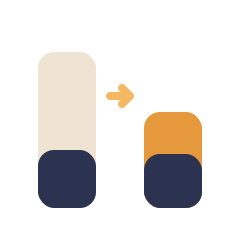
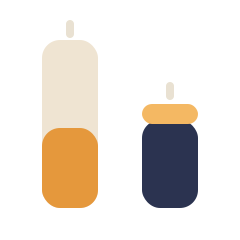
The meta-analysis of 24 weight-loss trials found higher protein groups kept about 0.43 kg more fat-free mass and lost about 0.87 kg more fat than standard protein groups over roughly twelve weeks.1 Total weight lost barely differed between them. That is the whole game in a deficit: the same kilograms, a different composition, and getting the protein in on fewer calories is the practical half.
Somebody who loses 10 kg and keeps their lifts has changed their body considerably. Somebody who loses 10 kg with 3 kg of it from muscle has lost more weight and ended up in a worse place, and the scale reported the second one as the better result.
The levers, which are the same either way
- Protein at the higher end. Around 1.6 g per kilogram is where gains in fat-free mass stopped rising in the training meta-analysis, and the sports nutrition range of 1.4 to 2.0 g/kg points at its upper part during a deficit.23
- Resistance training that still progresses, or at least holds. Load is the signal that the muscle is worth keeping.
- A moderate deficit. The larger the daily shortfall, the more of it comes out of lean tissue, which is the argument against aggressive dieting that actually holds up.
- Enough sleep, which affects both recovery and whether you can keep doing the first three.
The same three levers stated from the weight-loss side if you want the fat-loss framing.
Why the scale is the wrong instrument
If muscle goes up by half a kilogram and fat goes down by two, the scale reports one and a half kilograms and tells you nothing about the interesting part.
Better signals, none of them expensive:
- What you can lift, tracked over weeks. This is the most sensitive and most available measure.
- A tape measure, monthly, at the same points.
- How clothes fit at the same weight, which is a crude composition read.
- A DXA scan, twice, months apart, if you want it measured properly.
The trap worth avoiding
Trying to do both at once, badly. A deficit large enough for fast fat loss makes training hard, and training hard enough to build muscle makes a large deficit unsustainable.
The people who get the best results in this situation usually stop trying to optimise both and pick one to prioritise for a few months. If your training is going well and you are lean, a period at maintenance is more productive than another deficit. If you have substantial fat to lose, lose it while defending your strength, and expect to build afterwards.
Where this stops being general advice
The protein ranges here are for healthy adults training normally. If your protein intake is already managed as part of your medical care, your target is set by the clinician managing it and that takes precedence over anything on this page. The same applies if you are in a supervised weight-loss programme: follow the plan you were given rather than a general figure.
More questions about Muscle and training
Who can actually recomposition?
Three groups reliably: people new to resistance training, people returning after months away, and people carrying substantial fat, who have a large internal energy supply to draw on. Outside those, gaining muscle while in a deficit is slow at best and usually not what happens.
How large should the deficit be?
Moderate. The larger the daily shortfall, the more of the loss comes out of lean tissue, so an aggressive deficit works against the thing you are trying to do. A rate that lets you keep training hard is more useful than a faster one that does not.
Is holding my muscle a failure?
No, it is the intended outcome for most people. Losing 10 percent of your body weight while keeping your lifts is a substantial change in body composition, and it will look and feel like more than the scale suggests. Expecting to build at the same time is where the disappointment usually comes from.
References
- Effects of energy-restricted high-protein, low-fat compared with standard-protein, low-fat diets: a meta-analysis of randomized controlled trials
- A systematic review, meta-analysis and meta-regression of the effect of protein supplementation on resistance training-induced gains in muscle mass and strength in healthy adults
- International Society of Sports Nutrition Position Stand: protein and exercise