How much protein do I need to build muscle?
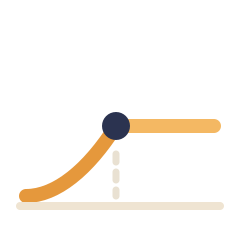
Around 1.6 g per kilogram of body weight a day is where the returns stop. In a meta-analysis of 49 resistance training trials, protein intake beyond about 1.62 g/kg/day produced no further gains in fat-free mass. The sports nutrition range of 1.4 to 2.0 g/kg/day brackets that figure comfortably. Tracking it means one daily target, each meal logged as you eat it, and a weekly look at the days you reached it.
Key takeaways
- Judge a training week by how many days reached the target, not by any single day.
- Gains in fat-free mass stopped rising past a total intake of about 1.62 g per kilogram a day across 49 trials.
- The measured effect of supplementing protein was 0.30 kg of fat-free mass and 2.49 kg on one-rep max. Real and modest.
- The effect shrank with age and was larger in people already resistance-trained.
- Protein is permissive, not causal. Training builds muscle; protein removes the material constraint.
- Very high intakes are described in the guidance as safe rather than as better.
This has one of the cleanest answers in nutrition, because somebody went and found where the curve stops rising.
The number
1.62 g/kg/day1
The total daily protein intake beyond which supplementation produced no further gains in fat-free mass, across 49 trials and 1,863 participants
That comes from a meta-analysis and meta-regression of resistance training studies, and the method matters: they used break-point analysis to find where the relationship between total protein intake and change in fat-free mass flattened.1 It is not a round number somebody liked. It is where the data stopped responding.
The sports nutrition position stand recommends 1.4 to 2.0 g/kg a day for people training to build or keep muscle, which brackets that figure comfortably.2 The two sources agree, arrived at differently.
How big the effect actually is
Worth stating plainly, because the number above is often quoted as though hitting it transforms things.
Across the same 49 trials, protein supplementation produced:
- 0.30 kg more fat-free mass
- 2.49 kg more on one-rep max strength
Over training periods of six weeks and longer.1 Real, statistically clear, and modest. Protein is not what builds muscle. Training builds muscle, and protein removes a constraint on it.
That framing explains an otherwise confusing pair of findings from the same analysis:
- The effect shrank with increasing age.
- The effect was larger in people already resistance-trained.
Both make sense if protein is permissive. If your training is not driving adaptation, there is no constraint for protein to remove.
What the arithmetic looks like
| Body weight | 1.4 g/kg/day | 1.6 g/kg/day | 2.0 g/kg/day |
|---|---|---|---|
| 60 kg / 132 lb | 84 g | 96 g | 120 g |
| 70 kg / 154 lb | 98 g | 112 g | 140 g |
| 85 kg / 187 lb | 119 g | 136 g | 170 g |
| 100 kg / 220 lb | 140 g | 160 g | 200 g |
Protein Buddy does this from a short quiz on your weight, age, how often you exercise and your goal, and sets the result as your daily target.
Two adjustments worth knowing. If you are carrying a lot of fat, scaling off total body weight overshoots, because fat tissue does not need feeding: an adjusted or lean body weight gives a more sensible figure. And if you are in a deficit, the higher end of the range is where the guidance points, which is a different situation with its own page.
Where the pound-per-pound rule came from
"One gram per pound of body weight" works out at roughly 2.2 g/kg, which sits above the point where gains stopped rising.
The Institute of Medicine did not set a tolerable upper intake level because the evidence was insufficient.3 That is not proof that any intake is safe. Sports guidance discusses higher intakes in healthy exercising adults, which does not establish safety for everyone or a benefit above the average breakpoint in these trials.2
The rule survives because it is easy to remember in pounds. That is the whole reason.
What matters more than the number
Once you are somewhere between 1.4 and 1.8 g/kg, the protein question is answered and the remaining variables are elsewhere.
- Training that progresses. Adding load, repetitions or sets over months. Without this, protein has nothing to permit.
- Consistency over years. Muscle is built in units of months.
- Distribution across meals, which is a smaller effect than the daily total. The position stand suggests about 0.25 g/kg, or 20 to 40 g, per serving, spread every 3 to 4 hours,2 and how much protein per meal has the arithmetic.
- Enough total food. Building tissue in a large deficit is a harder problem than most people assume.
If you have your number and your training is not progressing, the number is not the thing to adjust.
How to track your protein when you lift
- Set the targetA short quiz on your weight, age, exercise and goal sets it. Tap the gold goal card in Settings to adjust it in 5 g steps.
- Log each meal as you eat itType what you ate and the grams fill in, scan a barcode or set grams on the ruler. Repeats wait in the Recent tab.
- Check what is leftHome shows the grams left today, so by late afternoon you know how big dinner needs to be.
- Review the weekHistory marks each day at target as a filled oval, and Your insights adds Momentum and Weekly rhythm.
An 80 kg lifter at 1.6 g/kg aims for about 130 g. Oats, milk and a scoop of whey at breakfast log at 40 g, and Home reads 90g left today. A chicken and rice bowl adds 50 g, so 40g left. Greek yogurt after training brings it to 14g, and dinner closes it.
After a week, count the filled ovals and check whether the weekend drops, which is what Weekly rhythm compares.
Where this stops applying
These figures are for healthy adults training normally. If your kidney function is reduced, if you have liver disease, or if protein intake is already managed as part of your medical care, the target is set by your clinician and the ranges here are not aimed at you.
More questions about Muscle and training
How do I track my protein when lifting to build muscle?
Set a daily target from your body weight, around 1.6 g/kg, log each meal when you eat it rather than at night, and check the grams left before dinner. Then judge the week: how many days reached the target, and whether weekends drop. In Protein Buddy a short quiz sets the target, Home shows the grams left today, and History shows the week.
Is 1 g per pound of body weight necessary?
That figure works out at about 2.2 g per kilogram, which is above the point where the meta-analysis found gains stopped rising. That finding concerns average training gains, not a guarantee that any intake is safe for every person. It survives because it is easy to remember in pounds, not because a study landed on it.
Can I build muscle on less than 1.6 g/kg?
Yes. The figure is where the curve flattens, not a threshold below which nothing happens. Gains are possible below that average breakpoint. The analysis does not predict an individual result from an intake of 1.2 g/kg/day, or establish the outcome of choosing 1.3 rather than 1.6 g/kg/day.
Does it matter if the protein comes from food or powder?
Not for this. The meta-analysis measured total daily protein and found the ceiling in total intake, whatever the source. Powder is a convenient way to reach a number, and reaching the number is the part that matters.
References
- A systematic review, meta-analysis and meta-regression of the effect of protein supplementation on resistance training-induced gains in muscle mass and strength in healthy adults
- International Society of Sports Nutrition Position Stand: protein and exercise
- Dietary Reference Intakes for Energy, Carbohydrate, Fiber, Fat, Fatty Acids, Cholesterol, Protein, and Amino Acids