What is the difference between complete and incomplete protein?
A complete protein carries all nine essential amino acids in amounts a human can use. Meat, fish, eggs, dairy and soy do. Most other plant foods are short in one, usually lysine in grains and methionine in legumes. The practical effect is smaller than the wording suggests: variety across a day covers it.
Key takeaways
- Complete means all nine essential amino acids are present in usable amounts, not that the food is better in general.
- Meat, fish, eggs, dairy and soy are complete. So are quinoa and buckwheat, which is why they get named so often.
- Incomplete does not mean lacking. It means one amino acid is low enough to cap how much of the rest gets used.
- The rule about combining plant proteins at one meal was retracted by the person who popularised it. A day is the unit.
- On a plant-based diet the thing that actually needs raising is total protein, not the pairing of foods.
"Complete protein" sounds like a grade, as though some protein is the real thing and the rest is a compromise. The actual definition is narrower and more mechanical than that.
The definition
A protein source is complete when it contains all nine essential amino acids in amounts a human body can use.
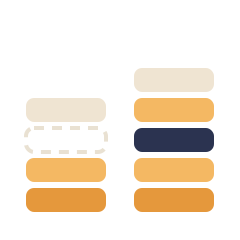
It is incomplete when one of them is low enough to limit the rest. That amino acid is called the limiting one, and it caps how much of the whole source can go into building anything, in the way one missing part halts an assembly line that has plenty of everything else.
Note what the word does not mean. Incomplete does not mean the food has no protein worth counting, and complete does not mean the food is a good source. Gelatine is animal protein and incomplete. Quinoa is complete and holds about 8 g in a cooked cup.
| Complete | What is limiting | |
|---|---|---|
| Meat, fish, poultry | Yes | Nothing in any practical sense |
| Eggs and dairy | Yes | Nothing in any practical sense |
| Soy: tofu, tempeh, edamame | Yes | Nothing in any practical sense |
| Quinoa, buckwheat | Yes | Nothing, though the amount per serving is modest |
| Beans, lentils, chickpeas | No | Methionine |
| Wheat, rice, oats, corn | No | Lysine |
| Nuts and seeds | No | Lysine, mostly |
| Collagen and gelatine | No | Tryptophan, which is absent |
The two shortfalls fit together
Grains run short of lysine. Legumes run short of methionine. Each covers the other's gap, which is why so many long-established cuisines pair them without anyone having planned it:
- Rice and dal
- Beans and tortillas
- Hummus and pita
- Beans on toast
- Peanut butter on bread
This is the observation that got turned into a rule, and the rule was the mistake.
The rule that was withdrawn
For about twenty years the standard instruction was that anyone not eating meat had to combine complementary plant proteins within the same meal. It came from a popular book published in 1971, and its author retracted it in a later edition.
The reason it was wrong: your body maintains a circulating pool of free amino acids, which buffers between meals. It does not need every component to arrive in the same sitting any more than a building site needs every delivery on the same lorry. Lentils at lunch and bread at dinner is fine.
The retraction has never fully caught up with the advice, which is why the rule is still repeated. If you take one thing from this page, take that one.
What actually matters on a plant-based diet
Dropping the combining rule does not mean there is nothing to think about. Two things survive, and neither is about pairing.
Total protein has to be higher. Plant proteins are digested less completely than animal ones, so the same number on a label delivers fewer usable amino acids. The scoring systems that measure this are covered in how protein quality is scored; the short version is that plant sources score lower and the gap is real.2
Lysine is the one to watch, if your intake leans heavily on grains and nuts rather than on legumes and soy. It is the amino acid most often limiting in a plant-based pattern, and legumes are the straightforward fix.
Both of those are answered by eating more legumes and soy, which is the same practical advice as hitting a protein target without animal foods arrives at from the other direction.
For everyone else
If you eat meat, fish, eggs or dairy at most days, completeness is already handled and there is nothing here to act on. The official recommendations are stated as total protein, not as amino acid profiles, precisely because for a mixed diet the profile takes care of itself.1
The number is the thing worth your attention, and where the daily number comes from is the page for it.
More questions about Protein basics
Is quinoa a complete protein?
Yes, in the sense the word is used: it carries all nine essential amino acids in usable proportions, which is unusual for a grain. It is worth keeping the amount in view though. A cooked cup is around 8 g of protein, so quinoa being complete matters far less than quinoa being a modest protein source.
Do vegans need to worry about incomplete proteins?
Not about combining them at a meal, which is the version most people have heard. The thing worth attention on a plant-based diet is total protein, because plant sources are digested less completely, and lysine in particular if grains make up most of the intake. Eating varied sources across a day handles the rest.
Is collagen a complete protein?
No. Collagen is missing tryptophan entirely and is low in several others, so it cannot be counted toward a protein target the way whey or a chicken breast can. It may still be worth taking for other reasons, but a scoop of collagen is not the same 20 g as a scoop of whey.
References
- Dietary Reference Intakes for Energy, Carbohydrate, Fiber, Fat, Fatty Acids, Cholesterol, Protein, and Amino Acids
- Values for digestible indispensable amino acid scores (DIAAS) for some dairy and plant proteins may better describe protein quality than values calculated using the concept for protein digestibility-corrected amino acid scores (PDCAAS)