What are the essential amino acids and do I need to think about them?
Nine of the twenty amino acids cannot be made by the body and must come from food: histidine, isoleucine, leucine, lysine, methionine, phenylalanine, threonine, tryptophan and valine. Animal foods carry all nine in useful amounts. Most plant foods are short in one, which matters over a day rather than at a meal.
Key takeaways
- Nine amino acids are essential, meaning your body cannot build them and food has to supply them.
- Leucine is singled out because it is the one that signals muscle to start building, not just the one that supplies material.
- A food is limited by whichever essential amino acid it has least of. For grains that is usually lysine; for legumes, methionine.
- The classic advice to combine plant foods within one meal has not held up. Over a day is enough.
- For almost everyone eating a mixed diet with enough total protein, none of this changes anything on the plate.
Twenty amino acids go into human proteins. Your body can build eleven of them from other material. The other nine it cannot, at any rate, and those are the ones food has to supply.
| Where it turns up in quantity | |
|---|---|
| Leucine | Dairy, whey, eggs, meat, soy |
| Isoleucine | Meat, fish, eggs, lentils |
| Valine | Dairy, meat, soy, peanuts |
| Lysine | Meat, fish, dairy, legumes. The one grains are short of |
| Methionine | Eggs, fish, sesame, brazil nuts. The one legumes are short of |
| Threonine | Meat, dairy, lentils, seeds |
| Phenylalanine | Meat, dairy, soy, nuts |
| Tryptophan | Turkey, oats, dairy, seeds |
| Histidine | Meat, fish, dairy, beans |
The label "essential" is doing something narrow here. It means your body cannot synthesise it, not that it matters more. The eleven you can build are needed just as much; they are simply not a supply problem.
Why leucine keeps being singled out
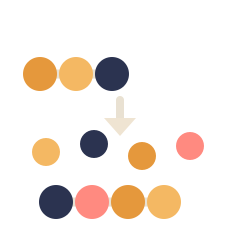
Amino acids do two jobs. They are the bricks, and one of them is also the doorbell.
Leucine is the doorbell. Beyond supplying material, it signals the machinery that builds muscle protein to switch on, which is why muscle research names it far more often than the other eight. A meal that delivers enough leucine triggers a building response; a meal that does not deliver much triggers a smaller one even when total protein looks reasonable.
This is the mechanism behind the advice to put a real amount of protein into each main meal rather than nearly all of it into dinner. That is covered properly in how much protein per meal, because the practical number is what people actually want.
It is also why branched chain amino acid supplements sell so well and do so little. Leucine is one of the three in a BCAA product, so the doorbell rings. Then the body needs all nine to build anything, and if the other six are not there, the response fades. Ringing a doorbell at an empty warehouse does not get you a delivery.
The limiting amino acid
A protein source is judged by whichever essential amino acid it has least of, relative to what a human needs. That one caps how much of the rest can be used.
- Grains are typically short of lysine.
- Legumes are typically short of methionine.
- Animal foods are short of none in any practical sense, which is the whole reason they score as they do.
Notice that the two plant shortfalls are opposites. Beans on toast, rice and dal, hummus and pita: these pairings are traditional in most cuisines with a long history of eating this way, and they are not a coincidence.
The advice that was withdrawn
For about two decades the standard instruction was that vegetarians had to combine complementary plant proteins within a single meal. That came from a popular 1971 book, and the author publicly retracted it in a later edition.
The reason it was wrong is that your body keeps a free pool of amino acids in circulation, which buffers across meals. Variety over the course of a day does the job. Eating rice at lunch and lentils at dinner is not a failure of planning.
What does still hold for a plant-based diet is quieter and more useful: total protein needs to be higher to reach the same delivered amino acids, because plant proteins are less completely digested and score lower on quality measures.2 How protein quality is actually scored goes into where those numbers come from, and hitting a target on plants into what it means at the shop.
When any of this changes what you eat
Honestly, for most people, never.
If you eat a mixed diet and hit a sensible total, the amino acid profile takes care of itself, and the intake range in the sports nutrition guidance is stated as total protein for exactly that reason.3 The nine are worth understanding because they explain why the rules exist, not because they are a fourth thing to track.
Two cases where it does become practical:
- Eating entirely plant-based, where lysine and total intake are both worth attention.
- Getting most of your protein from one narrow source, which is unusual outside of a very repetitive diet.
Everyone else can put this down and go back to the daily number.
More questions about Protein basics
How many essential amino acids are there?
Nine: histidine, isoleucine, leucine, lysine, methionine, phenylalanine, threonine, tryptophan and valine. Another group is called conditionally essential, meaning the body normally makes enough but may not during illness or stress. The remaining ones it can build from what is around.
Are BCAA supplements worth it?
For anyone getting enough total protein, they are hard to justify. Branched chain amino acids are three of the nine, and giving your body three of the nine does not let it build a protein that needs all nine. Whole protein sources already carry them, which is why the research consistently finds the interesting variable is total intake.
Do I need to combine plant proteins at every meal?
No. That advice came from a 1970s popularisation and its own author later withdrew it. Your body holds a free pool of amino acids that smooths across meals, so eating varied plant sources across a day is sufficient. Total protein and lysine are the things to watch, not the timing.
References
- Dietary Reference Intakes for Energy, Carbohydrate, Fiber, Fat, Fatty Acids, Cholesterol, Protein, and Amino Acids
- Values for digestible indispensable amino acid scores (DIAAS) for some dairy and plant proteins may better describe protein quality than values calculated using the concept for protein digestibility-corrected amino acid scores (PDCAAS)
- International Society of Sports Nutrition Position Stand: protein and exercise