Does protein help you keep weight off after losing it?
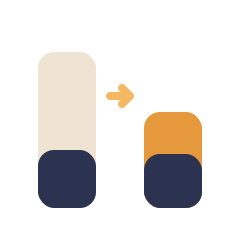
There is reasonable evidence that it helps. In a randomised trial, people who added 30 g of protein a day during six months of maintenance regained 0.8 kg against 3.0 kg in the control group, and their waist circumference fell rather than rose. It is a small old study and the most direct one available.
Key takeaways
- Maintenance is a separate phase with its own problem, and most weight-loss advice stops before it.
- In one randomised trial, an extra 30 g of protein a day meant 0.8 kg regained over six months against 3.0 kg.
- The protein group also lost waist circumference during maintenance while the control group gained it.
- Your target is per kilogram of body weight, so it falls as you do. Recalculate rather than carrying the old number.
- Muscle kept during the losing phase is the thing you are protecting, and it is easier to keep than to rebuild.
Almost everything written about weight loss stops at the point where the weight comes off. The harder phase starts there, and it has its own evidence.
The clearest trial
113 people with a BMI around 29 followed a very low energy diet for four weeks, then entered six months of maintenance. They were randomised into two groups: one added 30 g of protein a day on top of their usual diet, the other did not.
| Extra 30 g of protein | Control | |
|---|---|---|
| Weight regained | 0.8 kg | 3.0 kg |
| Waist circumference | Fell by 1.2 cm | Rose by 0.5 cm |
| Protein as a share of energy | 18 percent | 15 percent |
| During the initial weight loss | No difference between groups | No difference between groups |
The regain figures are the headline, and the waist measurement is the more interesting row: the two groups did not simply differ in kilograms, they differed in the direction of a body composition marker.1
Two caveats belong with it. The study is from 2005 and it is small. And the difference between the groups was three percentage points of energy from protein, which is a modest change producing a large-looking effect, so treat the size of it with some caution.
Why maintenance is its own problem
After weight loss, several things work against you at once.
Appetite rises. Losing weight increases hunger signalling, and it does not politely stop when you reach your target.
Energy expenditure falls. A smaller body costs less to run, so the intake that used to maintain your old weight now exceeds what you need.
The behaviours were temporary. This is the largest one and the least discussed. A diet with an end date has an end date, and what happens after it is usually a return to what came before.
Protein helps with the first two and does nothing about the third. It is worth being clear about that ratio.
Your number moved
Protein recommendations are stated per kilogram of body weight, which means the grams change when your weight does.
Somebody who went from 95 kg to 80 kg at 1.4 g/kg has gone from 133 g a day to 112 g. Carrying the old target forward is not harmful and it is no longer what the recommendation says. Recalculate it once, in how the daily number is worked out or in Protein Buddy, where the target can be edited any time, and then leave it alone.
What you are actually protecting
The muscle you kept during the losing phase. That is easier to hold than to rebuild, and it is the reason the maintenance argument and the losing-phase argument are the same argument in two parts.
It is also the mechanism behind the small energy-expenditure benefit: more lean tissue costs more to maintain, which is a slight tailwind rather than a solution.
Two things that pair with it:
- Keep the training. For the same reason as during the loss: material without a signal to use it does less.
- Keep weighing yourself, weekly rather than daily. The drift back is gradual enough to be invisible without a record, and 3 kg over six months is about 100 g a week.
The part that decides it
The long-term protein trials are messier than the short ones, and the review attributes that mainly to whether people kept to the diet they were given.2
That is the same conclusion again from a different direction: the gap between a higher protein diet and an ordinary one is smaller than the gap between a plan you keep and a plan you drop. Which is also the argument for a maintenance habit that is cheap enough to sustain, rather than an intense one that lasts a month. The self-monitoring literature is consistent that people who keep some form of tracking do better, with the operative word being keep.3
Tracking one number instead of everything exists for exactly that trade.
A note on scope
This is reference material about healthy adults maintaining a weight loss. If your intake is managed as part of your medical care, or you came out of a supervised programme with a plan, that plan is set by a clinician who knows your history and it takes precedence over the figures here. Weight that moves sharply in either direction without an obvious cause is also worth a conversation with a doctor rather than a change to a target.
More questions about Weight loss
How much protein should I eat during maintenance?
The recommendations do not have a separate maintenance figure. They are set per kilogram of body weight, so the rate stays similar while the grams fall with your weight. The trial that found a maintenance benefit used an extra 30 g a day on top of an ordinary diet, which took the group from about 15 to about 18 percent of energy from protein.
Why do people regain weight?
Several reasons at once: appetite rises after weight loss, energy expenditure falls somewhat, and the behaviours that produced the loss are usually harder to sustain than to start. Protein addresses part of the first and helps preserve the muscle that supports the second. It does not address the third, which is the largest.
Should I keep tracking after I hit my goal?
Something worth keeping is a periodic check rather than nothing at all. The drift back is gradual and invisible day to day, and people who keep some form of self-monitoring do better in the weight-loss literature. Tracking one number is a lower-effort version of that than a full food diary.