What does protein actually do in the body?
Protein supplies amino acids, which your body uses as building material: muscle, skin, hair, enzymes, antibodies, and the proteins that carry things around your blood. Unlike fat and carbohydrate it is not stored for later, so the supply has to arrive roughly daily. That is the reason protein is tracked as a number per day rather than per week.
Key takeaways
- Your body uses protein as building material and can also use it for energy. It breaks protein into amino acids to build its own proteins.
- There is no protein store. Fat has adipose tissue and carbohydrate has glycogen; protein has your working tissue, which is why a shortfall is paid for out of muscle.
- Around 250 to 300 g of protein is broken down and rebuilt inside you every day, most of it recycled rather than eaten.
- The RDA is 0.8 g per kilogram of body weight a day, the intake that covers nearly all healthy adults. It is a reference for avoiding deficiency, not a target for the best outcomes.
- Eating far more than you can use does not build anything extra. The surplus is used for energy like anything else.
Most writing about protein starts at the number. This starts one step earlier, because the number makes a lot more sense once you know what it is a number of.
Building material and energy
Carbohydrate and fat are mostly energy. Your body burns them, and what it does not burn it puts away.
Protein is different in kind. You do not use the protein in a chicken breast; you take it apart into amino acids and build your own proteins out of the pieces. Muscle is the famous one, but by count it is a minority use.
- Skeletal muscle, and the connective tissue holding it to bone
- Enzymes, which run essentially every chemical reaction you depend on
- Antibodies, which help the immune system recognise specific targets
- Haemoglobin, which is the reason your blood carries oxygen
- Collagen and keratin, which are skin, hair and nails
- Peptide hormones, including insulin
That list is why "protein is for people who lift" is a misreading. Training raises the requirement. It does not create it.
Nothing here is permanent
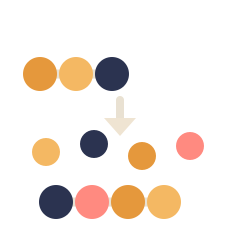
The part that surprises people is how much of this is torn down and rebuilt continuously. Something in the order of 250 to 300 g of protein is broken down and resynthesised inside an adult every day, which is several times more than anyone eats.
Most of that is recycling: the amino acids from a dismantled protein are reused rather than thrown away. Food covers the shortfall, because the recycling is not perfect and some nitrogen is lost every day regardless.
So the picture is not a tank you fill. It is a building site running permanently, where deliveries have to keep arriving because material keeps being consumed.
There is no protein store, and that is the whole point
Fat has adipose tissue. Carbohydrate has glycogen in your liver and muscle. Protein has nothing equivalent.
The nearest thing to a reserve is your own working tissue. When food does not supply enough amino acids, the body takes them from where they already are, and the largest accessible pool is skeletal muscle. It is not being wasteful; it is prioritising the enzymes and antibodies that keep you alive over the muscle that gets you up the stairs.
Two consequences follow, and they are the practical content of this whole section of the site.
- The intake is daily. Not weekly, not averaged. A big Sunday does not cover a thin Tuesday, because there is nowhere to keep the surplus.
- A shortfall is paid for out of muscle. This is why protein comes up so insistently around losing weight and around getting older, which are the two situations where the shortfall is largest and lasts longest.
Where the official number comes from
The Recommended Dietary Allowance is 0.8 g of protein per kilogram of body weight a day for healthy adults, set by the Institute of Medicine in 2005 from nitrogen balance studies.1
Read what that method asks. It measures the intake at which nitrogen going in matches nitrogen coming out, for almost everybody. That is a floor: the point at which you stop losing. It was never an answer to "what intake gives the best outcomes for muscle, recovery or ageing", and it is regularly quoted as though it were.
The same report set an acceptable range of 10 to 35 percent of daily energy from protein, and declined to set an upper limit at all, for want of evidence rather than because none is possible.1
The working number for most people sits above the floor. How the daily target is actually worked out goes through the recommendations by situation.
What more of it does not do
Since protein is material, it is tempting to read "more material, more building". That is not how it behaves.
Sports nutrition guidance works in the range of 1.4 to 2.0 g/kg a day for people training to build or keep muscle, and describes intakes beyond that as safe rather than as better.2 Past the point where your body has what it needs, extra amino acids are not held in reserve. The nitrogen is stripped off and excreted, and the rest is used for energy exactly like any other calorie.
Which is worth knowing before buying anything: the ceiling on what protein can do for you is set by what your body is currently building, not by how much you can get down.
If you want the practical end of this, the reference figures for everyday foods turn all of it back into groceries.
More questions about Protein basics
Is protein stored in the body like fat?
No. Fat is stored as adipose tissue and carbohydrate as glycogen, but there is no equivalent reserve for protein. The nearest thing is your own working tissue, mostly skeletal muscle, which the body will draw on when the supply from food falls short. That is why the intake is a daily number rather than a weekly one.
What happens to protein you do not need?
The amino acids are not held over. The nitrogen part is removed and excreted, and what remains is used for energy or stored as fat like any surplus. This is why very high intakes stop adding benefit at some point: you are not building more, you are buying an expensive source of calories.
Do you need protein if you do not exercise?
Yes. Muscle is the visible use, but it is not the main one by count. Enzymes, antibodies, peptide hormones, transport proteins in your blood, skin, hair and nails are all protein, and all of them turn over whether or not you train. Training raises the requirement rather than creating it.