Do I need protein powder?
Only if you are struggling to reach your target from food. Powder is convenient protein with nothing special about it: in the trials, supplementation adds muscle and strength during training, and the benefit stops once total intake reaches about 1.6 g per kilogram a day. It solves a logistics problem, not a nutritional one.
Key takeaways
- Powder is a convenience, not a category of nutrition. Your body cannot tell a whey shake from cottage cheese.
- In 49 trials of people doing resistance training, supplementation added 0.30 kg of fat-free mass and 2.49 kg to one-rep max.
- The same analysis found no further gains beyond a total intake of about 1.62 g per kilogram a day.
- It earns its place when appetite is low, when time is short, or when a target is genuinely hard to reach from meals.
- Supplements are lightly regulated, so third-party testing is the only real quality signal on the tub.
The useful question is not whether protein powder works. It is what job you are hiring it for, because the answer changes completely depending on that.
What the trials actually show
The largest analysis of this pooled 49 studies covering 1,863 people doing resistance training, and compared supplementing protein against not supplementing.
1.62 g/kg1
The total daily protein intake beyond which supplementation added no further fat-free mass across 49 trials
Supplementation added 0.30 kg of fat-free mass and 2.49 kg to one-rep max strength over the training periods studied. Real, measurable, and modest.1
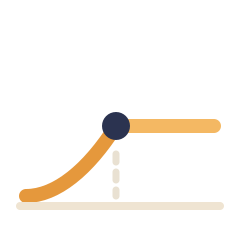
The number in the figure is the one worth carrying around. Past a total intake of about 1.62 g per kilogram a day, adding more protein stopped producing more fat-free mass. Not "supplements stopped working": total protein stopped working. The powder was never the active ingredient.
Two other findings from the same analysis are worth knowing. The effect was smaller with increasing age, and larger in people already resistance-trained. So the group most likely to buy powder on a first visit to a gym is the group it does least for.
What it is for, then
Powder is a delivery format. It solves problems of time, appetite and portability, and it does not solve anything else.
| A scoop of whey | A pot of Greek yoghurt and some nuts | |
|---|---|---|
| Time to prepare | Under a minute | Two minutes |
| Fibre | None | Some |
| How full it leaves you | Not very, it is a drink | Considerably more |
| Cost per 25 g | Usually cheaper | Usually more |
| Works when appetite is gone | Yes, this is its best case | Often not |
| Feels like eating | No | Yes |
When it earns its place
- Appetite is suppressed. Liquid protein goes down when food does not, which is why it comes up so often for people on a GLP-1 medication.
- The target is high relative to how much you can eat. Someone at 1.8 g/kg who trains has a genuinely demanding number to hit from meals alone.
- Mornings are the problem. If breakfast is otherwise coffee, a shake is 25 g that would not have existed. A protein coffee recipe that mixes without clumps is the same fix in a familiar cup.
- You are plant-based, where reaching a total from whole foods means a lot more volume.
When it does not
- You are already hitting your target. There is nothing further to buy; that is what the 1.62 g/kg figure means.
- You are adding it on top rather than instead. Then it is calories, and calories are not the thing you were short of.
- You want it to do something food does not. It does not. The sports nutrition position stand puts the recommendation in terms of total protein, not supplements.2
Reading a tub
Three checks cover most of it.
- Protein per 100 g, not per serving. A "30 g serving" is often 24 g of protein and 6 g of other things. Comparing on the per 100 g figure is the same habit as reading any food label.
- Third-party testing. Supplements are regulated more lightly than food in most markets, so a certification mark from an independent testing body is worth more than anything printed on the front.
- The ingredient list length. Whole-protein powders are short. Long lists usually mean thickeners, sweeteners and flavours, which is a preference rather than a problem, but you are buying less protein per gram.
Which type to buy, and whether whey is actually better than the plant options, is a separate question with a clearer answer than most: whey, casein or plant. If the powder is for weight loss, the best protein powder for weight loss for women turns these checks into a five-point label test.
One case where the answer is not ours to give: if your protein intake is already managed as part of your medical care, adding a concentrated source is a question for the clinician managing it rather than a shopping decision. The intake ranges on this page are for healthy adults.
More questions about Protein in food
Is protein powder better than food?
No, and in one respect it is worse: it brings none of the fibre, micronutrients or fullness that come with a meal. What it brings is 25 g of protein in a minute with no cooking, which is a real advantage on a busy morning and no advantage at all on a Sunday.
Will protein powder make me gain weight?
Only in the way any food does. A scoop with water is around 110 kcal; the same scoop blended with milk, banana and peanut butter is closer to 500. Powder added on top of what you already eat adds calories. Powder replacing something else does not.
Is protein powder safe?
For healthy adults, whole-protein powders are food in a tub and the intake ranges they help you reach are well within what the sports nutrition guidance describes as safe. Supplements are lightly regulated though, so look for third-party testing on the label. Anyone whose protein intake is managed as part of their medical care should ask their clinician before adding one.